“We were delighted with their transparency, honesty, and fantastic communication. Very punctual and high quality outcomes.”
When a Company Enters Insolvency: Preserving Its NetSuite Records for the Trustee and Counsel
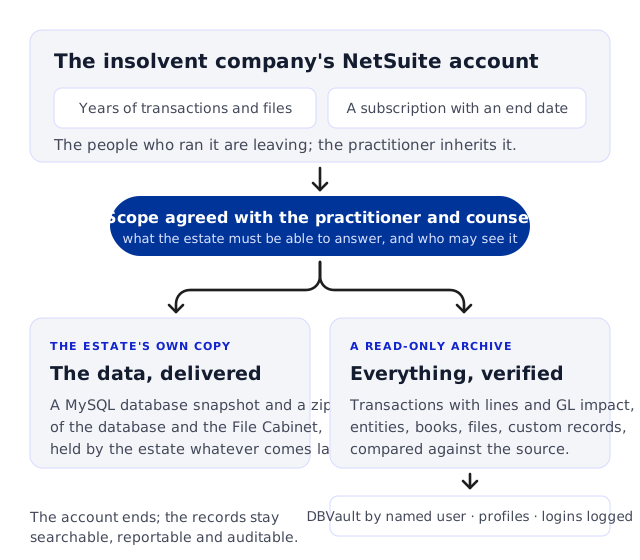
When a company enters an insolvency, its NetSuite account is one of the things the trustee, receiver or monitor inherits, and rarely one the estate wants to keep paying for. The people who ran it are leaving or gone, the subscription ends on a date the contract sets, and the records inside it will be asked for long after that date by creditors' advisers, tax authorities and a purchaser of the business. We have worked with trustees, and with law firms and their partners, when an ERP had to be archived in an insolvency. For the practitioner and counsel, this page sets out what the archive has to hold, how it is verified when nobody from the original finance team is there to vouch for it, who sees it afterwards, and what we do not do. The seller's side is on the divestiture and entity separation page.
The company has a practitioner, and its ERP has a date
The NetSuite account holds the ledger, the invoices, the payments and the files behind every figure in the last accounts, and its subscription runs to a date in a contract the estate did not write. Three ways exist to deal with it; only one keeps the records usable without keeping the account.
Keep the account open and pay for it
The subscription renews for a company that no longer trades, and someone in the practitioner's office has to administer its seats. The estate carries the cost for as long as anyone might ask a question. What a read-only account buys, and keeps costing, is on the caretaker licence cost page.
Export what someone thinks will be needed
Saved searches and spreadsheets, run by whoever is still there before they leave. What comes out is a set of lists without the relationships between them: the payment without the invoice it settled, the journal line without its transaction, the bill without its attachment. We repeatedly see manual methods fail on relationships and custom objects; in an insolvency the person who ran the export is rarely there to explain it.
Extract the whole account into a verified archive
The whole account is extracted with its relationships intact and verified against the source at the database level. It is then hosted read-only, where the practitioner's staff, counsel and anyone the estate admits can search and report from it without a NetSuite licence. This is what we do, with AcroXtract for the extraction and DBVault for the access.
What has to happen before the account ends
The order matters more here than anywhere else: the people who know the account are leaving, and the date is not the practitioner's to move.
1 · Establish who authorises the extraction
Extraction is a customer-authorised activity run with the customer's own credentials. Here the customer is the company under the practitioner's control, the practitioner, or the law firm acting for them. Whoever administers the account creates a dedicated read-only login for the extraction, and little else is asked of the remaining staff until acceptance.
2 · Size the account and fix the date
Database size, File Cabinet size, subsidiaries, accounting books, the number of people who will need the archive, and the date the subscription ends under its contract. If entries have already stopped, one full extraction is the whole job.
3 · Full extraction
Account mapping, indexing, database creation and record extraction run against the account as it stands, by AcroXtract, custom records and File Cabinet included.
4 · Cut-off and delta, where entries continue
Where the practitioner's team keeps posting after the appointment, a delta extraction picks up every record that changed since the first pass, identified by record hashing, and the combined set is verified again.
5 · Verification and acceptance
Extracted records are compared against the source at the database level. Then the people who will rely on the archive, the practitioner's staff and any retained employee who knows the books, work it against the questions they expect, with issues tracked as tickets until sign-off.
6 · Delivery
Access on DBVault for the named people, and the data itself as a MySQL database snapshot and a zip of the database and the extracted File Cabinet, so the estate holds its own copy whatever happens to the hosting later.
What the company's archive has to hold
The GL impact of every transaction, so a trial balance and general ledger can be run for the periods before the appointment.
Transactions with their lines, payments with their applications, journal entries with every line.
The customers, vendors, items and accounts those transactions resolve to.
Each accounting book where Multi-Book is in use, and every subsidiary the account held.
File Cabinet attachments linked to the records they support: the invoice behind a claim, the contract behind a bill.
Custom records and custom fields, named as they were in the account.
If the business, or part of it, is sold
A purchaser takes what the sale agreement gives it, usually figures and master data loaded into its own system by its own team. The archive stays with the estate; the purchaser's people can be given access as named users under a restriction profile where the agreement provides for it. We do not load archived data into the purchaser's ERP or NetSuite account, and we do not split an archive by entity as a service; where data later has to move, we assist and supply it in CSV or MySQL form.
How the practitioner and counsel know the archive is right
The practitioner relies on records it did not create, from a team it may never have met, and will be asked to stand behind them. Verification runs in layers; the vendor's own controls are part of what counsel reviews.
Automated comparison against the source
Extracted records are compared against the NetSuite account at the database level, not by a spot count, as a fixed step of every AcroXtract engagement.
Reconciliation to the last figures reported
Because the archive holds the GL impact of every transaction, a trial balance and general ledger can be run for the company's final periods and set against the figures it last reported. When the original finance team is gone, that is the check the practitioner's own staff can run.
Relationships and attachments
Transactions still resolve to their customers, vendors, items and lines, and File Cabinet documents open from the records they support. A folder of exported files cannot pass this check; the difference shows the first time a claim has to be set against the invoice and the payment behind it.
Acceptance, and the vendor's own controls
A formal validation period with ticket-based issue reporting until sign-off. For counsel's review of the vendor, Blueacrobat is ISO/IEC 27001:2022 certified and SOC 2 Type II audited; one engagement below began with the customer's security audit of the vendor, cleared before any access was granted.
Who sees the company's records afterwards
The people who need the archive after an insolvency were rarely users of the account: the practitioner's staff, counsel, creditors' and purchasers' advisers, auditors and tax reviewers asking about the periods before the appointment. On DBVault each is a named user with a restriction profile.
The practitioner's staff and counsel
Search by transaction number, document number, entity, e-mail or memo; open a transaction with its lines, GL impact and attachments; reproduce an invoice or a bill as a document when a claim or a dispute turns on it. Financial reports run from the archived data for the periods before the appointment.
Parties the estate admits
Where the practitioner decides that a creditor's adviser, an auditor or a tax reviewer may see part of the record, a profile limits that person to the archive, the record types, the File Cabinet folders and the subsidiaries the question covers. Each is an allow list or a deny list. Direct browsing of the File Cabinet can be switched off, so documents open only from records they may already see.
A purchaser of the business
Where the sale agreement gives the purchaser access to the company's history, a profile scoped to that one archive gives it and nothing else; other archives in the tenant are not shown. Login events and download history are kept, so who saw what after the sale has an answer. Restrictions apply to viewer roles; administrators cannot be restricted.
What this does not do
It does not give legal, audit or accounting opinions, decide what the estate must keep, for whom or for how long, or review, interpret or classify the records. Those are the practitioner's and counsel's decisions; we extract what is in scope, verify it against the source, and give authorised users the means to search, view and export it.
It does not load the company's history into a purchaser's ERP or NetSuite account, and it does not restore an archive into a NetSuite account. We supply the data in CSV or MySQL form and work alongside the team doing any load.
It does not split an existing archive into independent archives as a service.
It is cloud-hosted only; there is no on-premises option.
Workflows locked in the NetSuite user interface are not part of a data archive.
When to start, and what shapes the cost
The useful moment is the appointment, or the day the practitioner learns when the subscription ends. Everything else is scheduled backwards from that date, and in an insolvency it is often closer than in any other situation. If you are already inside that window, say so.
The sizing form on the AcroXtract page collects database size, File Cabinet size and user count, and a quote for the extraction and for DBVault hosting follows from those. Hosting is an annual subscription; the estate decides how long it runs, and when it ends the MySQL snapshot and the zip delivered at the start are still its own.
Counsel's review of the vendor can run alongside the sizing: the controls and certifications are set out on the Trust Centre page. This page quotes no figures; the comparison with keeping the account open is on the caretaker licence cost page.
Engagements with the same shape
All case studiesNone of the published case studies is an insolvency; the three below share its shape: an education provider concluding its operations with every financial record to keep, a company whose whole history came out for record retention once its security audit of the vendor was cleared, and a manufacturer on a tight deadline for whom most quotes were beyond reach.
- Case StudyChief Information Officer, education companyRead more
- Case Study
“They covered their bases well and knew exactly what we needed ahead of us asking.”
Zach Koopman, Head of IT and Information Security, GutCheckGutCheck: NetSuite history extracted for record retention, through a vendor security audit
Read more - Case Study
“They turned an impossible-seeming challenge into a managed, on-budget success.”
Executive, manufacturing companyNetSuite extraction in days for a manufacturer on a tight migration deadline
Read more
Questions asked by trustees, receivers and counsel
We have been appointed over a company that runs NetSuite. Its finance team has left and the subscription ends soon. What do you need from us?
A read-only login to the account, created by whoever administers it now, and the sizing inputs: database size, File Cabinet size, subsidiaries, accounting books and the number of people who will need the archive. The extraction then runs without the company's staff. Acceptance needs someone able to say the archive answers the estate's questions, usually the practitioner's own accounting staff; where nobody from the original team is available, the reconciliation to the figures the company last reported stands in.
Can the archive produce a trial balance and general ledger for the periods before the appointment?
Yes. The archive holds the GL impact of every transaction, so financial reports run from the archived data: trial balance, balance sheet, income statement, general ledger, P&L by subsidiary, department, class or location, and audit reports such as the transaction journal, for the periods, subsidiaries and accounting books the account held.
A creditor's adviser, an auditor or a tax authority asks for records. Can we give them access without giving them the whole company?
Yes, where the practitioner decides to. Your administrator grants access to named users, and a restriction profile limits a user to particular archives, record types, File Cabinet folders and subsidiaries, as an allow list or a deny list, with direct file browsing switched off. Who may see what is the estate's and counsel's decision; the platform applies it.
The business is being sold. Can the purchaser take the archive, or have the history loaded into its system?
The estate holds the data as a MySQL snapshot and a zip of the database and the File Cabinet; what it hands to a purchaser under the sale agreement is its decision. The purchaser's people can be given named-user access to the archive on DBVault under a profile scoped to it. Loading the history into the purchaser's ERP or NetSuite account is the receiving team's own migration activity; we supply the data in CSV or MySQL form and do not load it ourselves.
Do you give an opinion on what has to be kept, or on the records themselves?
No. We do not decide retention, legal-hold or disclosure questions, and we do not review, interpret or classify the records. We extract what is in scope, verify it against the source, and give authorised users the means to search, view and export it. The archive can support a discovery or an audit in that sense; the opinions are counsel's and the auditor's.
Who is the customer: the estate, the law firm, or the company?
Whoever has authority over the account and its records: the company under the practitioner's control, the practitioner, or the law firm acting for them; we have worked with each. The DBVault tenant is administered by the customer's own administrator, who grants and removes access. Restriction profiles apply to viewer roles; administrators cannot be restricted.
Entries were still being posted after the appointment. Do we have to wait until they stop?
No. The full extraction runs while entries continue; when the practitioner's team has posted its last entries, a delta extraction picks up what changed and the combined set is verified again. The mechanics are on the extracting while the account is live page.
Tell us about the company's NetSuite account
Tell us who has been appointed, whether entries are still being posted, and when the subscription ends. We will walk through what the archive has to hold, how it is verified when the original finance team is gone, who can see it afterwards, and what the estate receives.