
Case Study
“Successful access to the entire NetSuite database for all years including attachments.”
VP of IT Strategy and Data, software company
A read-only NetSuite archive with attachments, for a software company's users
Read more
.svg)
When an SAP instance is switched off, the postings inside it stop being reachable. Finance still needs the history, auditors still ask for it, and a licence kept alive for look-ups is no longer an option worth paying for. DBVault for SAP is where that history lives afterwards: the SAP flavour of DBVault, our cloud-hosted platform for ERP and business data archival and reporting. It holds your SAP financial data as a read-only, relational archive your finance team can search, scope access to and produce financial statements from, per company code and fiscal year, without an SAP licence. It is filled by AcroXtract for SAP, and it runs on the same platform as every other archive we host.
Finance is the scope to date: the records a statement, an audit or a tax question is built from, held per company code and fiscal year, with the relationships between them intact. The archive is built from your extract, so what it holds is what the scope agreed, and it keeps SAP's own structure rather than flattening it.


Every posting with its document, its account, its company code, its cost centre, its profit centre and its internal order, for the fiscal years in scope. A ledger line still connects to the document that produced it.
Open customer and vendor items, customer and vendor master data with their company-code views, and the chart of accounts, so a balance can be followed to the parties behind it.
Asset accounting and the controlling objects your reporting is built on, held as records of their own with their relationships, not as a flat export that has to be reconnected by hand.
Where your business depends on a custom table, it is brought into scope alongside the standard objects, so the parts of your system that were built for your business are not the parts that go missing.
An archive that will stand up to an audit is a project with a fixed sequence, run together with your SAP team. The scope is agreed before the work starts, and nothing is signed off until it reconciles to your own books.

Which company codes, fiscal years, ledgers and object families are in scope, which custom tables come with them, and what stays out. You cannot verify what you did not know to extract.
The packages are produced from SAP's own reporting and table exports, to a specification agreed in scoping, with your SAP team and under credentials you control. We take them from there.
The packages are loaded into the archive's own schema with the relationships between postings, documents, accounts and master data kept, and custom tables loaded as record types of their own.
Row counts per table against the package, documents netting to zero, and the trial balance tied to your own balances per company code. A plausible row count is not treated as proof.
Your team works the archive against real questions, raises anything that looks wrong as a ticket inside it, and signs off only when those are cleared. From then on DBVault runs as a managed service.

Relationships between postings, documents, accounts and controlling objects.
The ledger per company code, fiscal year and period.
Open items and master data as records of their own.
Custom tables alongside the standard objects.
Records read-only once finalised, with logins and downloads logged.
CSV export from every list, so the data can leave.
An SAP archive is built from extract packages, not from a connection to your system. Where postings continue after the first package, a closing package taken after the last close replaces the earlier load, so the archive is complete to the period you agreed, and the reconciliation is repeated on it.
The statements run inside the platform against the archived ledger, per company code and fiscal year, and the postings stay reachable from each figure, so a reviewer can move from a balance to the documents behind it without an SAP licence and without a spreadsheet first.

Cumulative, consolidated and fiscal-year trial balance, balance sheet, income statement, general ledger, account activity and transaction detail: the reports a close, an audit or a statutory filing is normally built from.

Profit and loss by cost centre, profit centre and company code, in the dimensions SAP kept; trial balance by currency and FX analysis where the extract carries the currencies, so a group can still reconcile a prior period the way it was originally reported.

Transaction journal, period comparison, account type summary and the reversals report, for the questions that arrive from outside the business, where showing the working matters as much as the number.

The archive keeps SAP's own structure: company code, cost centre, profit centre and business area carry through to the reports, so a controller reads them the way the books were kept. Which reports are available depends on the dimensions the extract carries; the reports you rely on are confirmed during scoping and tested during your validation period, and access to the statements follows the same roles as the rest of the archive.
The second question every security review asks of an archive is who can see what, and whether you can prove who saw it. The answer is a mechanism, administered by you, and on an SAP archive the company code is one of its axes.
Administrator and read-only viewer roles. A viewer's access is restricted by archive, record type and company code, each as an allow list or a deny list, through a named profile you can reuse; the product's own example is an auditor profile. Archives outside the profile are not shown.
An auditor or a divisional controller can be given one archive and the company codes they are responsible for, and nothing else. What they see, they can filter by fiscal year and period; what they were not given does not appear.

Login events and download history are kept inside the platform. Your administrator invites users, assigns profiles and removes access when an engagement ends; sign-in uses multi-factor authentication, with single sign-on available.
Restrictions apply to viewer roles; administrators cannot be restricted.
A profile does not limit by date; a viewer filters what they can see by fiscal year and period.
Attachments held in SAP (GOS and ArchiveLink documents) are outside the scope to date; the archive holds the postings and the master data.
Sales and distribution, materials, HR and plant maintenance are outside the finance scope to date.
It does not load data into S/4HANA or another system; records leave as CSV for the team doing a load.
It is cloud-hosted only; there is no on-premises installation.
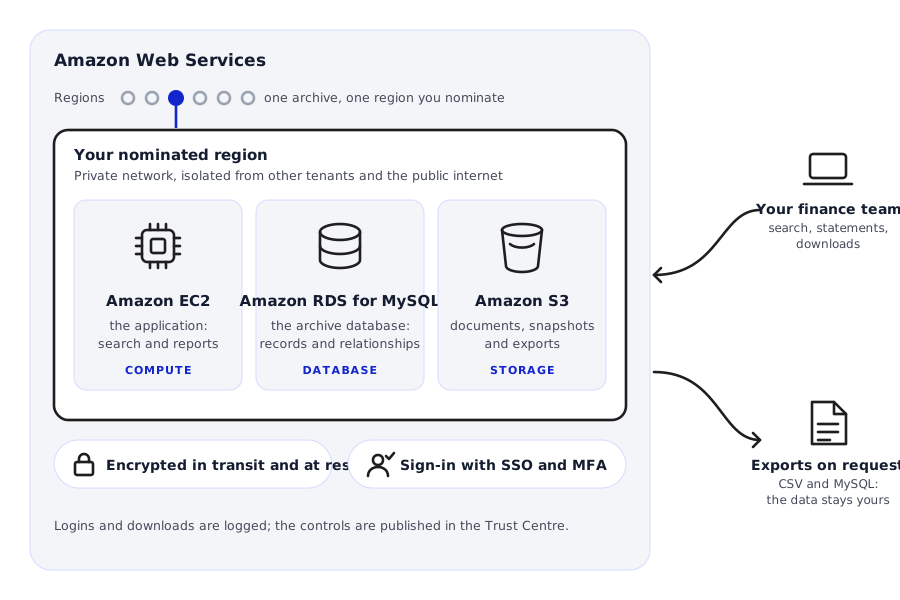
On Amazon Web Services, encrypted in transit and at rest, with network isolation; where residency is a requirement, an archive can be provisioned in a nominated region. Blueacrobat is ISO/IEC 27001:2022 certified and SOC 2 Type II audited, and the controls are published in our Trust Centre.
Hosting is an annual subscription, sized on the volume of data held and the number of users who need access; the extraction is a project, scoped and priced from a short sizing exercise with your SAP team. There is no SAP licence to renew and no per-report charge.
The data stays yours. Every list in the archive exports to CSV, so keeping the history does not depend on the subscription continuing, and a team loading data elsewhere is handed the files it needs.
Each of these organisations retired a system and kept its history on the same platform. The write-ups describe NetSuite archives; an SAP engagement is described on this site only with the customer's written approval.
“Successful access to the entire NetSuite database for all years including attachments.”
“Blueacrobat is efficient, professional and cost effective.”
“Their product, DBVault, was built and readily available to use after data extraction.”

.webp)
SAP ECC and SAP S/4HANA. The archive is built from the financial data your SAP team extracts, per company code and fiscal year; the release decides which reports and tables the packages come from, not what the platform can hold.
Together with your SAP team. The extract packages are produced from SAP's own reporting and table exports, to a specification agreed in scoping, under credentials you control; we load them into the archive, reconcile them to your own books and put the result in front of your team for validation. Where postings continue after the first package, a closing package after the last close replaces the earlier load.
Yes. DBVault is the platform for ERP and business data archival and reporting; DBVault for SAP and DBVault for NetSuite are its flavours. The search, the access controls, the logging and the reporting are the same; what differs is what the archive holds and how it is named. An SAP archive keeps SAP's own structure and dimensions.
Yes. A viewer's restriction profile can name the archive, the record types and the company codes the person may see, as an allow list or a deny list. An auditor given one company code sees nothing else, and filters what they can see by fiscal year and period.
Not to date. The archive holds the postings, the open items, the master data, asset accounting, the controlling objects and the custom tables in scope; documents attached in SAP through GOS or ArchiveLink are outside the scope so far. Say during scoping if they matter to you.
Yes. Every list in the archive exports to CSV. There is no direct API for feeding a downstream migration, so where data is being moved into another system it is handed over in that form for the team performing the load.
On Amazon Web Services, encrypted in transit and at rest, and it can be provisioned in a nominated region where data residency is a requirement. The platform is cloud-only, with no on-premises installation. The controls are on the Trust Centre.
Hosting is an annual subscription, sized on the volume of data held and the number of users who need access. The extraction is a project, scoped and priced from a short sizing exercise with your SAP team, and a quote follows from it rather than from a list price.

Tell us which company codes and fiscal years the history covers and who will need it afterwards. We will show DBVault answering a real question against SAP data like yours, reports included, and set out what it would take to get your archive onto the platform.
.svg)

.svg)


.png)
.png)