.svg)

DBVault for Oracle NetSuite: Data Archival and Access Platform
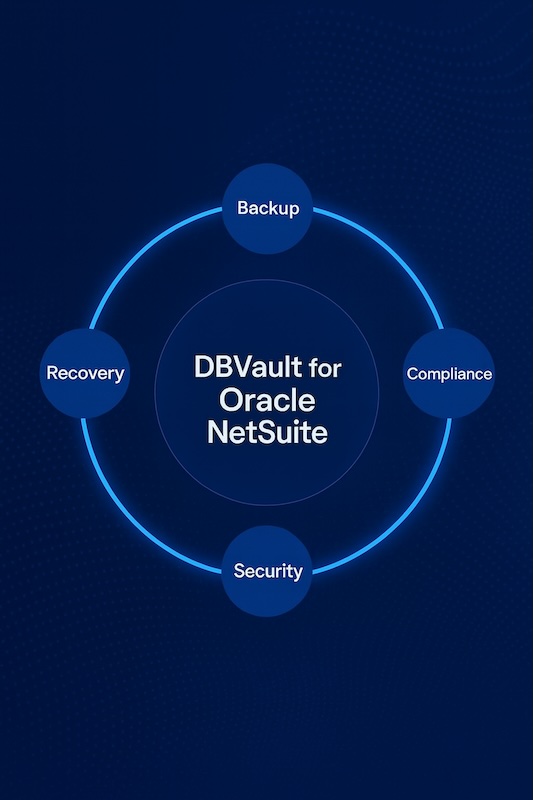
When an ERP is switched off, the records do not stop being needed. Auditors ask for a trial balance from a closed year. A tax authority opens a period. A customer disputes an invoice raised in a system nobody logs into any more. DBVault for NetSuite is where that history lives afterwards: a read-only, cloud-hosted platform holding your archived Oracle NetSuite data in relational form, searchable by your own finance team, and able to produce the financial statements the question actually calls for rather than a folder of exported files. It is the NetSuite flavour of DBVault, the platform we run for ERP and business data archival and reporting.
Financial reporting on archived data
This is what turns stored records into something a finance team can use. Most retention products give you records back. DBVault also gives you the statements built from them, produced inside the platform against the archived ledger, without a live NetSuite account and without exporting to a spreadsheet first. When an auditor asks for a trial balance for a closed year, the answer comes from the archive itself.
Reports run against the archive as it was captured, and the underlying records stay reachable from each figure, so a reviewer can move from a balance to the transactions behind it without leaving the platform. Access follows the same role-based permissions as the rest of DBVault, which means a read-only reviewer can be given the statements without being given the ability to export everything.

Financial statements
- Cumulative trial balance
- Consolidated trial balance
- Period activity balance
- Balance sheet
- Income statement
- General ledger
- Account activity
- Chart of accounts
- Transaction detail
The reports a close, an audit or a statutory filing is normally built from.

Management reporting
- Profit and loss by department
- Profit and loss by class
- Profit and loss by location
- Profit and loss by subsidiary
- Revenue by customer
- Expenses by vendor
Historical performance stays comparable across the years that sit either side of a system change.

Multi-currency
- Trial balance by currency
- FX analysis
A group operating in several currencies can still reconcile a prior period the way it was originally reported.

Audit and compliance
- Transaction journal
- Period comparison
- Account type summary
- Reversals report
For the questions that arrive from outside the business, where showing the working matters as much as the number.
Archived NetSuite data your finance team can still use
Most retention plans solve storage and leave usability unsolved. A database dump on its own can satisfy a policy, but a finance team cannot
answer an auditor's question from it without a database specialist in the loop. DBVault stores transactions, journal entries, invoices, audit trails and custom records with their
relationships intact, and puts a search and reporting interface in front of them, so the archive can be used by the people who are actually
asked the questions.
That access does not depend on a live ERP licence or a running environment.
Organisations retiring a NetSuite account frequently keep a read-only seat open purely so somebody can look something up. Once the history is
in DBVault, that reason to keep paying goes away, and the retention obligation is met by a system built for it. The options after cancelling, and how each person's access is scoped, are compared in
Access to NetSuite data after you cancel.
DBVault is
delivered as a managed cloud service with role-based access control and retention governance, built first for Oracle NetSuite and extended to
other ERP systems as those engagements have required it.
Every archive is delivered with a validation period. Your team raises anything that looks wrong as a ticket inside the archive, and sign-off happens only after those are cleared. From then on DBVault runs as a managed service, with logins and downloads logged and the controls published in our Trust Centre.
.png)

Legacy ERP Data

Oracle NetSuite Decommissioning
.png)
Legacy Archives

Retire NetSuite

Data Retention & Compliance

Archival hosting for one instance or several
One platform can hold more than one archive, so a group that ran several NetSuite instances, or is retiring more than one system, keeps its history in one place under one set of access rules. Each archive keeps its own schema and the relationships between its records.
Search that works the way finance expects
Search across the whole archive, with filters by date, transaction type, subsidiary and custom field, so a finance user finds a record the way they did in NetSuite. Each record opens with its sublists and attachments in place.
Retention that outlasts the ERP
Retention obligations under SOX, GDPR, PIPEDA and sector rules usually run for years after the ERP is switched off. DBVault keeps the records producible for the whole period, with a log of who viewed and who exported what, without keeping the old system alive.
Read-only, encrypted and logged
Archived data is encrypted in transit and at rest and held read-only once finalised, with login events and downloads logged. Blueacrobat is ISO/IEC 27001:2022 certified and completes a SOC 2 Type II examination annually.
Access scoped to what each person should see
Administrator and viewer roles, with viewer access restricted by archive, record type, File Cabinet folder and subsidiary, as an allow list or a deny list. Direct File Cabinet browsing can be switched off, so files are reachable only through records a user is permitted to see.
Fed by the extraction and backup services
DBVault is fed by our services. AcroXtract, the extraction and archival service, is the main one: it takes a one-time extraction from a NetSuite account being retired and turns it into the permanent archive the platform hosts. Where an account is staying live rather than being switched off, AcroBackup for NetSuite, our continuous backup service, feeds the same platform with a daily copy instead.
What DBVault changes for the business
The archive is a relational database, not a set of files, and every relationship between records is preserved. That is what allows it to be searched, reported on and defended later.
Archives in use on DBVault today: Away’s NetSuite records and File Cabinet, ready to use the moment extraction finished, a telecommunications company’s legacy NetSuite archived for audit and a software company’s read-only archive with every attachment accessible.

Retire the read-only NetSuite seats kept open only for lookups, and stop paying to hold inactive data in the live account.

Answer audit and regulatory requests from the archive itself, with self-service access for the people who are asked.

Keep the history reachable through an ERP migration, a consolidation or a decommissioning, without loading it into the new system.

Meet retention obligations from an archive that is read-only once finalised, with every login and download logged.
Why Choose DBVault?

Experience with the difficult account
We have extracted and archived NetSuite data for HPE, Kimberly-Clark, Dropbox, Snapchat, NetApp and many others: long-lived instances, heavily customised accounts, multi-book and multi-subsidiary structures. The archives in use on DBVault today are described in the case studies, in the reviewer's own words.

Legacy Oracle NetSuite ERP Data
Every archive goes through a validation period before sign-off. Your team checks counts, relationships and reports against the source
account and raises anything that looks wrong as a ticket, and the archive is accepted only when those are cleared.

Oracle NetSuite Decommissioning
Extraction runs against your own account with credentials you control and can revoke. Where a cut-over date is fixed, a delta extraction
captures what changed between the main pull and the final close, so the archive is complete to the last day the account was live.

Accessible, Audit-Ready Archive
Auditors, tax authorities and your own finance team get a scoped, read-only view and the reports they ask for, with logins and downloads
logged. Blueacrobat is ISO/IEC 27001:2022 certified and SOC 2 Type II examined annually, and the controls are published in our Trust Centre.
Questions we are usually asked
Can we produce financial statements from the archive?
.webp)
Yes. Trial balance, consolidated trial balance, balance sheet, income statement, general ledger, account activity, chart of accounts and transaction detail run inside DBVault against the archived ledger, alongside management reports by department, class, location and subsidiary, multi-currency reporting and audit reports such as the transaction journal and reversals. No live NetSuite account is required to run them.
What is the difference between DBVault and AcroXtract?
DBVault is the platform; AcroXtract is the service. AcroXtract extracts your data out of a NetSuite account that is being retired and builds it into a permanent read-only archive. DBVault is where that archive lives afterwards and how your team reaches it: search, permissions, exports and financial reporting. Most engagements are exactly this pairing, because archival is what the majority of our customers come to us for. The platform also hosts the output of AcroBackup for NetSuite, our continuous backup service, for organisations whose NetSuite account is staying live.
Is DBVault only for NetSuite?
No. DBVault is the platform for ERP and business data archival and reporting; DBVault for NetSuite is its NetSuite flavour, and the one this page describes. Oracle NetSuite is where most of our engagements have been and where our tooling runs deepest. The same platform hosts the SAP archives delivered through AcroXtract for SAP. If your system is not named on this site, describe it during scoping; the answer depends on how its data can be read.
Who can see what?
Access is role-based, with administrator and read-only viewer roles, single sign-on, multi-factor authentication and IP-based restrictions where you want access limited to known networks. An external auditor can be given a scoped view for the period they are examining without being given the account.
Can data be changed once it is in the archive?
No. The archive is held read-only once it is finalised, and every login and download is logged. That is the property that makes it worth producing a statement from: the figures cannot have been edited after the fact, by us or by anyone at your organisation.
Can we get the data out again?
Yes. Records can be exported to CSV, and the archive can be taken as a MySQL database. There is no direct API for feeding a downstream migration, so where data is being moved into another system it is handed over in those formats for the team performing the load.
Where is it hosted, and can we run it ourselves?
On Amazon Web Services, encrypted in transit and at rest, and it can be provisioned in a nominated region where data residency is a requirement. The platform itself is cloud-only, with no on-premises installation; the archived database can still be delivered to you as a MySQL copy to hold on your own infrastructure. Blueacrobat is ISO/IEC 27001:2022 certified and undergoes an annual SOC 2 Type II examination, and the controls are available for review in our Trust Centre.
How is it priced?
As an annual subscription, sized on the volume of data held, the size of the File Cabinet content and the number of users who need access. Those figures come from a short sizing exercise, and a quote follows from it. How that compares with keeping a read-only NetSuite account is set out on the caretaker licence cost page.
See the archive answer a real question
Bring the question your auditors, your tax team or your finance function keep coming back to the old system for. We will show you DBVault answering it against data like yours, including the reports, and set out what it would take to get your history into it.
.svg)

.svg)


.png)
.png)