.svg)


A migration plan usually has a line for the old system: switch it off on a date. It rarely has a line for what the old system held. The finance team that closed the last period in it, the auditor who will ask about that period in three years, and the customer who will dispute an invoice raised in it all still need the records after the licence ends. Retiring the account is a system event; the data responsibility outlasts it.
Which obligations survive the account?
- Retention rules. Financial and transactional records carry retention periods set by tax law, company law and sector regulation, and by the company's own governance policy. The period runs from the transaction, not from the day the system was retired; the retained data is usually the longest-lived thing the migration leaves behind.
- Audits and investigations. An auditor asks for a trial balance for a closed year, the journal behind a balance, the invoice behind a line, and the document attached to the invoice. A tax authority opens a period. Litigation asks for the history of a contract. Each request arrives after the people who ran the migration have moved on.
- Financial reporting. Comparatives across the years either side of a system change only work if the earlier years can still be reported the way they were originally reported: by subsidiary, by period, by accounting book.
- Customers and suppliers. Past orders, contracts, pricing and remittances are the evidence in a dispute, and a supplier's history is what a renegotiation is based on.
- Migration validation. The new system is reconciled against the old one at cut-over; opening balances and master data have to be traceable back to where they came from.
What does keeping the data actually require?
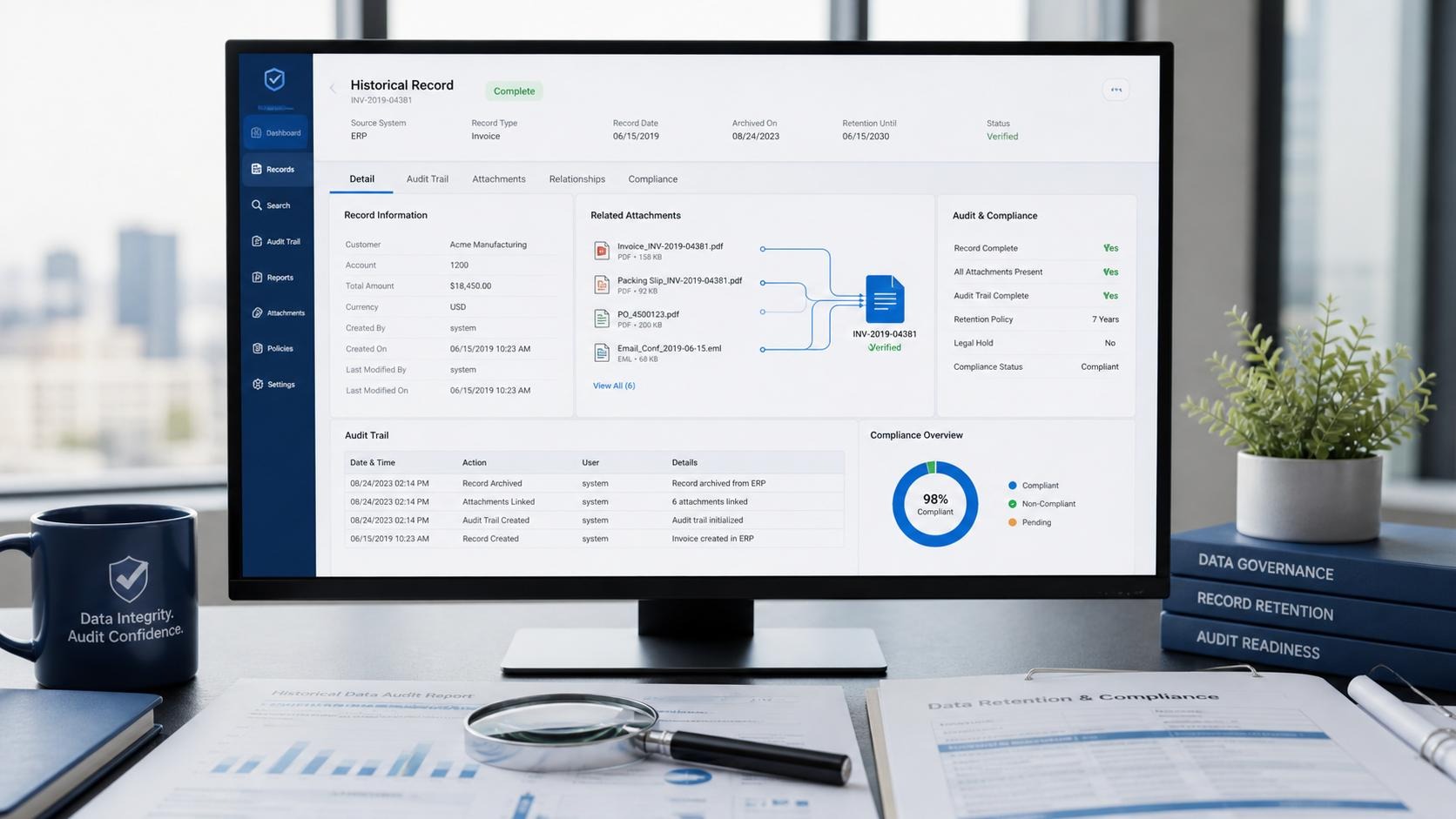
Possession is not usability. A folder of CSV exports satisfies a retention policy on paper and fails the first real request, because the question an auditor asks depends on how records connect. An invoice has to resolve to its customer, its sales order, its payments, its lines, its GL impact and its attachments; a flat file of invoices has lost all of those links. Keeping the data means keeping the records, the relationships between them, the custom records and fields the account accumulated, the File Cabinet documents attached to transactions, and a way for a finance user to search all of it without a database specialist in the loop.
It also means knowing the copy is complete. A matching row count shows that rows arrived; it does not show that values, relationships or attachments survived. The export verification guide sets out the four layers that do: counts by record type, financial totals, referential integrity, and field-level inspection, followed by acceptance by the people who will rely on the archive.
How do we keep it usable without keeping NetSuite?
Companies keep NetSuite history in one of three ways. They keep a read-only account open purely so somebody can look things up, and pay for it for years. They take a one-off export and hope the relationships survive. Or they extract the account into a hosted, read-only archive before access ends. Only the third gives finance self-service access after the account is gone without a spreadsheet becoming the system of record. The options are compared in Access to NetSuite data after you cancel.
The third option is the work Blueacrobat does. AcroXtract extracts the structured records, their relationships, the custom objects and the File Cabinet from the account, compares the result with the source, and delivers it as a database you own. DBVault hosts that archive: read-only, searchable, with named roles and restriction profiles, and financial reporting for the periods it covers, so a trial balance for a closed year comes from the archive itself. Neither loads data into the successor ERP; the team implementing that system does, from what we deliver. If the account is staying live rather than being retired, the need is different, and it is served by continuous backup.
The decision is not whether the data has been exported. It is whether finance, audit and IT can still use and validate it after the account is gone. If your account has an end date, the sequence and the order of work are on the NetSuite decommissioning page.

.svg)