.svg)

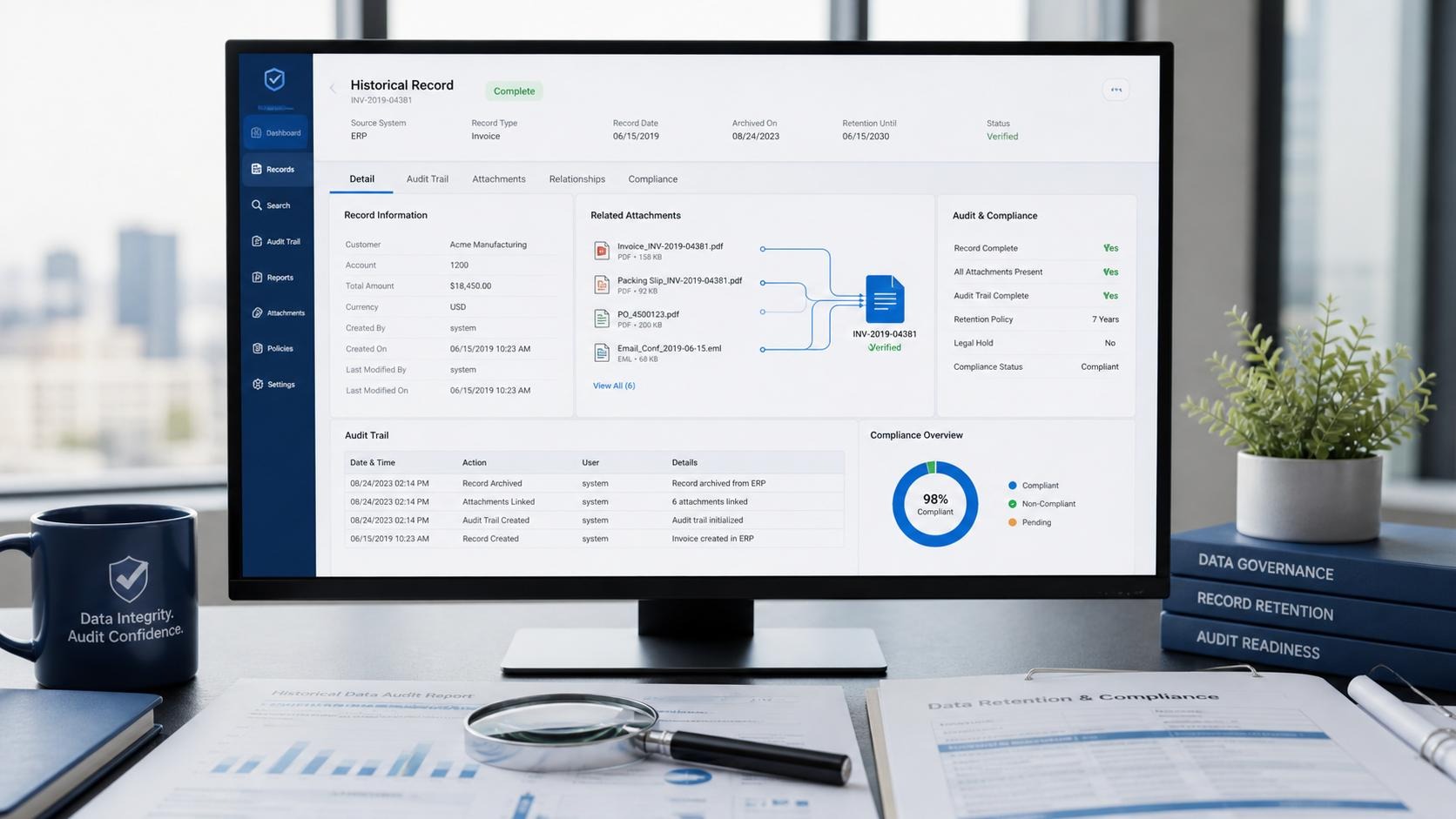
The general ledger answers the question of what was posted. The document attached to the transaction answers the question of why, and that is the one an auditor, a tax authority or a customer in dispute asks. When a NetSuite account is retired with the GL archived and the File Cabinet left behind, the second question can no longer be answered from the record.
What gets lost when only the GL is archived?
- The context for an audit. Contracts, invoices as issued, remittances and internal correspondence stored as attachments are the evidence behind the posting. Exporting the files without the link to the record they belong to leaves a folder of documents nobody can place.
- The custom structure. Accounts accumulate custom record types over years, such as a run-tracking record linked to a sales order or an item fulfilment. A generic export does not carry those links, and the relationship is what made the record meaningful.
- The time of every search. With the link kept, a proof of delivery opens from the fulfilment record it belongs to, and a message thread opens from the transaction it was about. Without it, somebody searches a disconnected folder tree by file name, for every request, for years.
How do attachments stay findable from their records?
By extracting the File Cabinet as part of the record extraction rather than as a separate download. AcroFile copies the folders in scope out of the account with the folder structure, the file names and the link between each file and its record intact, and delivers them to storage you control. Hosted on DBVault, a document is then reachable from the record it was attached to, and a viewer's access to files can be restricted to the records that viewer is permitted to see. The delivered set is compared with the index taken at the start, so what came out can be checked against what was there.
Do we have to archive everything?
No, and the scope decision is worth making deliberately. The record extraction aims at everything that is accessible, but logs, superseded custom records and folders nobody will ask for can be excluded, which reduces the size of the archive, the length of the project and the cost. The rule is that the exclusion is written down before the extraction, not discovered after the account has closed. The full sequence for an account being retired, and where the File Cabinet sits in it, is on the NetSuite decommissioning page; if the File Cabinet is in your scope, AcroFile is the service that takes it out.


.svg)